Public statements, press releases, and selected board comments.
This page collects EASL 3616 statements and press releases by date, along with selected board comments when they are relevant. When available, we include links to the public meeting video.
Latest
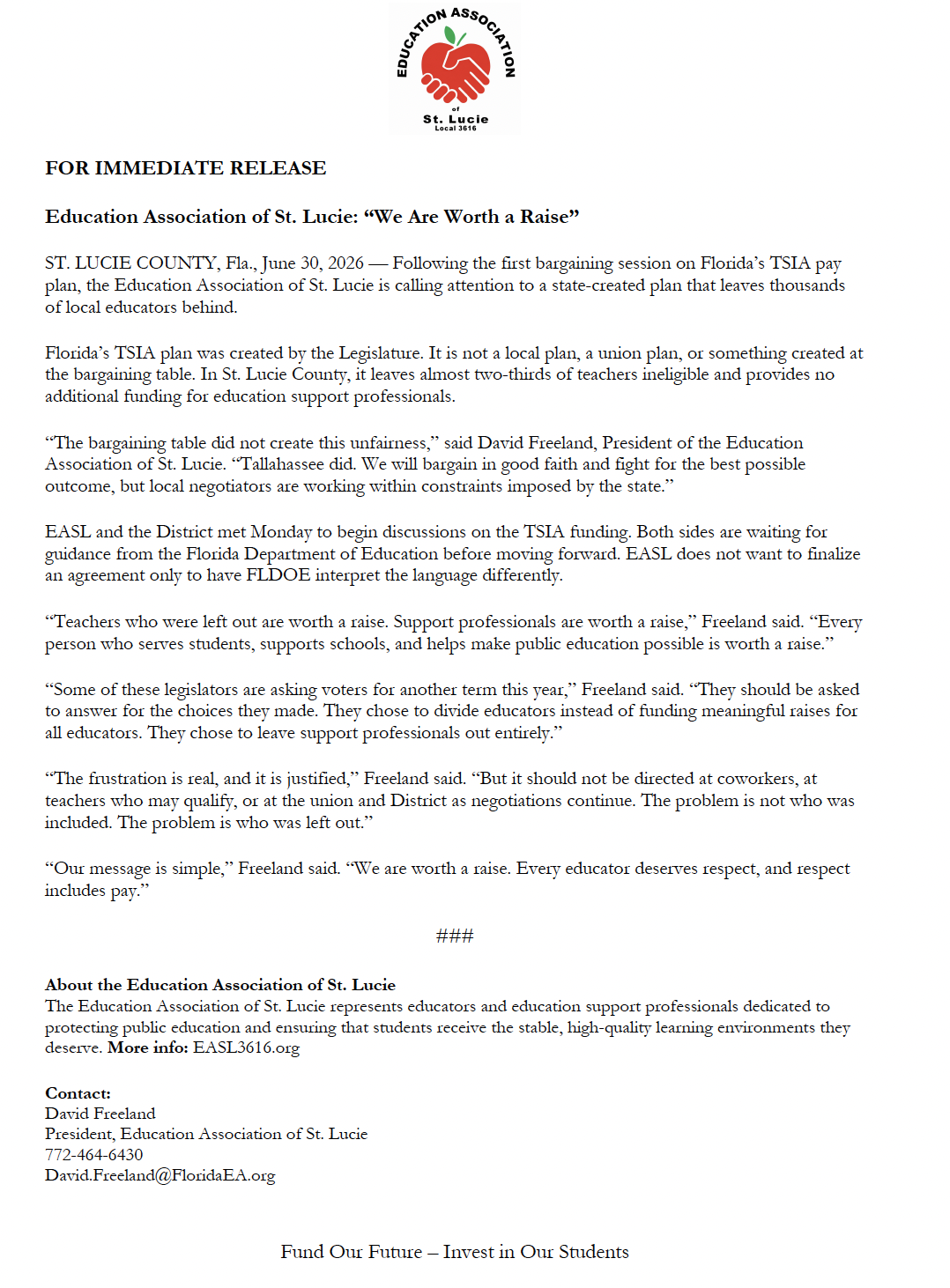
Following the first bargaining session on Florida’s TSIA pay plan, EASL is calling attention to a state-created plan that leaves thousands of local educators behind. The release makes clear that the unfairness was created in Tallahassee, not at the bargaining table.
Press Releases
A dated archive of EASL 3616 press releases (most recent first).
Public Comments
Public remarks delivered outside School Board meetings when they provide useful context or address a significant issue.
Transcript
Good morning.
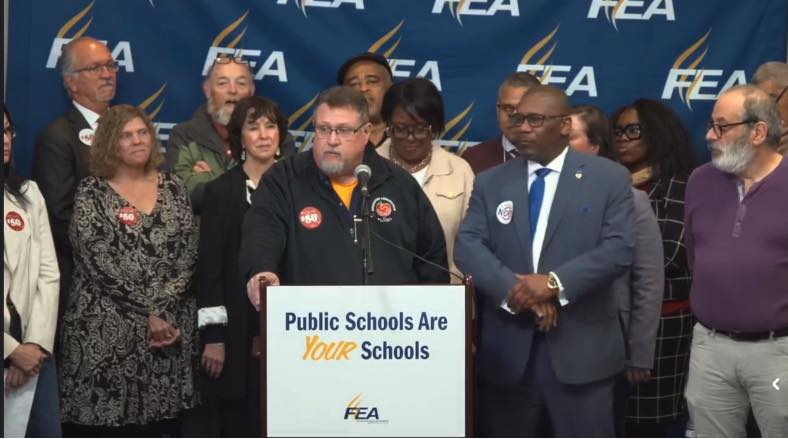
I’m David Freeland, a math teacher in St. Lucie County and President of the Education Association of St. Lucie.
I come from a family of educators. My dad taught. My mom taught. My sister teaches. And so do I. It’s the family business. So yes, I take this personally, but I’m going to keep this practical and student-centered. In St. Lucie, we’re not debating policy in the abstract. We’re living the consequences every day. When policy misses the mark, this is what it looks like in real schools.
We had a teacher with a STEM (Science, Technology, Engineering, and Math) master’s degree who couldn’t receive credit because she was certified in math, not “STEM,” even though Florida doesn’t offer a STEM certification and even though the “M” stands for math. She left the profession. Our students lost a highly trained educator. That kind of box-checking doesn’t improve instruction. Students lose. (SB 320)
Let’s talk about multi-year contracts. Every year, we lose educators because without them, there’s nothing to stop constant job-shopping or leaving the profession for more stable work. On paper, it looks like a staffing issue. In real life, it’s a student issue. Students need stable learning environments. They need teachers who stay long enough to build relationships and grow programs. Teachers should be able to focus on teaching, not whether they’ll have a job next year. (SB 320)
That’s why I’m calling on House leadership to agenda HB 963. It addresses advanced degrees, ten-year certificates, and multi-year contracts. These aren’t technical details. They are the levers that determine whether talented educators stay in classrooms.
I also need to address HB 995, because I am a union president and because it matters for students. Unions are not outside organizations. They are the people doing the work in schools. Collective bargaining is a constitutional right in Florida, and it is one of the primary ways educators raise concerns early, before they become crises. When educators lose their voice, problems go unaddressed, conditions deteriorate, and students feel the impact. HB 995 makes it harder for educators to maintain that voice. Weakening voice does not reduce bureaucracy. It reduces responsiveness, stability, and student support.
None of this is helped by piling more bureaucracy onto schools that are already stretched thin. Stability, flexibility, and trust — that’s what helps students succeed.
So my request is simple: support and advance the bills that reflect listening to educators and communities, like HB 963 and HB 1187, and oppose legislation like HB 995, which adds bureaucracy and makes it harder for those closest to the work to have a voice in their profession. These decisions matter because they directly shape student outcomes in classrooms across Florida.
Thank you.
Board Comments
Selected comments to the School Board when they provide useful context or address a significant issue.
Transcript
Chair Ingersoll, members of the Board, Superintendent Prince,
The state announced school grades on July 1, and St. Lucie earned its second “A” in as many years.
I was out of town, two time zones away, and I heard almost immediately. That is how important this accomplishment is.
I appreciate the Board’s desire to celebrate this achievement publicly. It deserves to be celebrated.
Congratulations. This is a real achievement, and it belongs to this entire district: students, families, staff, and this Board.
As we celebrate tonight, I want to point something out:
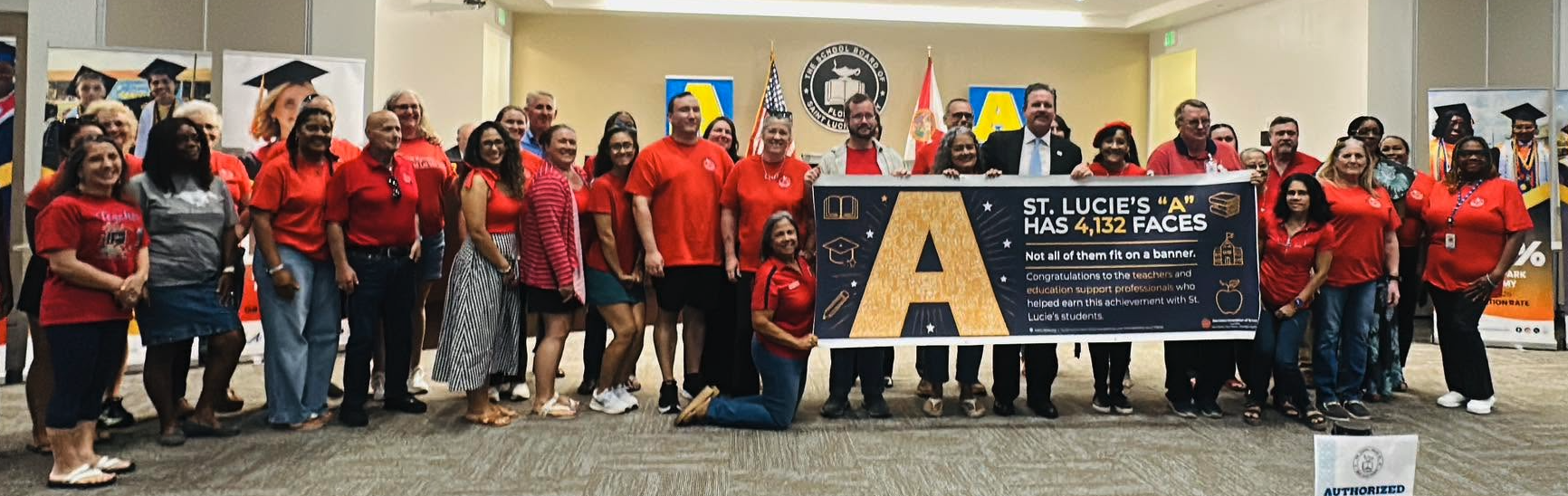
St. Lucie’s “A” has 4,132 faces.
And those faces do not fit on a banner.
They are on buses and in classrooms, front offices, clinics, media centers, cafeterias, and schools across the district.
Every one of those faces did the work, every day, to earn our A.
A’s happen because teachers come in early, stay late, grade papers on weekends, jump through the hoops the state creates, take the real work home, and call parents at night.
A’s happen because paraprofessionals and classroom aides support students individually and in classrooms, work alongside teachers, help families, and do whatever is needed to help students succeed.
A’s happen because clerical staff, nurses, assessment clerks, and education support professionals keep every school running, every single day.
And even 4,132 faces don’t tell the whole story.
This A also happened because of people who are not in our bargaining units: bus drivers who get students to school and home safely, food service workers who make sure students are fed and able to concentrate, and custodians and maintenance staff who keep our buildings running.
This A happened because our families and our community support our schools, support our employees, and support our students.
Most of all, this A happened because students showed up and did the work themselves.
The Education Association of St. Lucie represents 4,132 bargaining unit members. They are the faces behind the A, and I am proud to call them my colleagues.
Some are here tonight.
If you are an educator, paraprofessional, clerical employee, nurse, assessment clerk, or education support professional, would you please stand?
These are some of the faces behind St. Lucie’s “A.”
Most of the 4,132 bargaining unit members we represent could not be here tonight.
Some are preparing for the new school year.
Some are working second jobs.
Some are at home with their families after giving this district everything they had this year.
But every one of them helped earn this “A.”
So, on behalf of the Education Association of St. Lucie, we would like to present this banner as a gift to the district.
[Present the banner.]
We hope it will be displayed prominently and proudly as a reminder that St. Lucie’s “A” has 4,132 faces.
Not all of them fit on a banner.
Thank you.
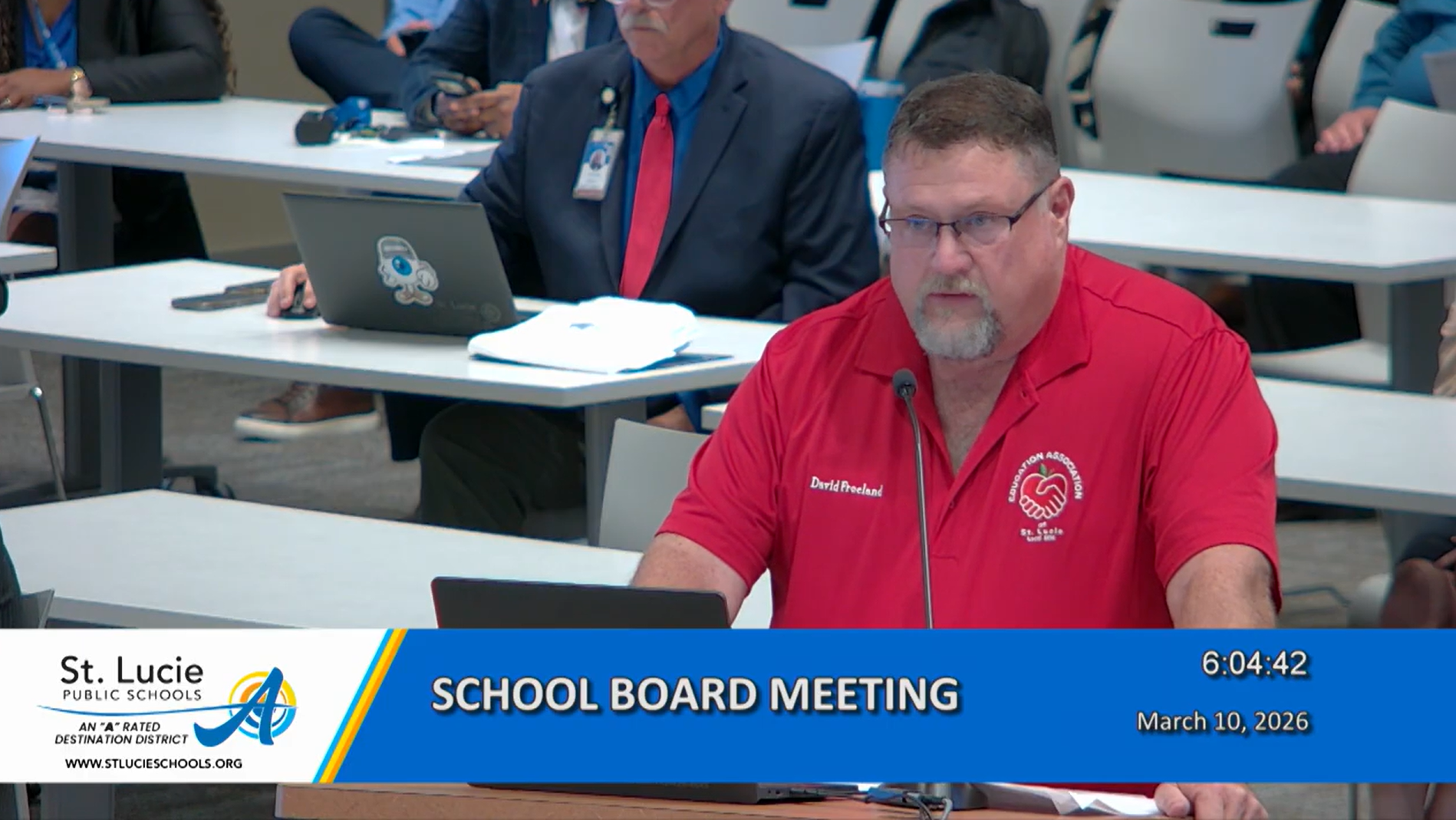
Transcript
Good evening.
Many of you have probably seen the film Dead Poets Society.
In one early scene, the students open their poetry textbook and are told that poetry can be measured with a formula — a graph of importance on one axis and perfection on the other.
The teacher instructs them to calculate the greatness of a poem.
And then Robin Williams’ character tells them to tear that page out.
Not because structure is bad. Not because curriculum is bad. The point of that scene isn’t rebellion. It’s a reminder that learning cannot be reduced to a formula.
Right now, many of our classrooms are starting to feel a little too much like that textbook page.
Curriculum is no longer just what teachers teach. Increasingly, it dictates how they teach, when they teach it, what resources they use, and sometimes even what they are expected to say.
Everyone must be on the same page, using the same material, delivering the same lesson in the same way at the same time.
That assumes every classroom is identical.
It assumes every student learns the same way.
It assumes every teacher’s strengths are identical.
I have taught for nearly three decades, nineteen years in St. Lucie, and I have watched this shift happen gradually — and then all at once.
For years we talked about the art and science of teaching. In fact, our entire teacher evaluation framework is built on Marzano’s The Art and Science of Teaching.
The science matters. Standards matter. Research matters. But somewhere along the way, we seem to have abandoned the art. And that raises a simple question.
If our framework is built on Marzano’s Art and Science of Teaching, when did we decide the art no longer mattered?
The art is the professional judgment teachers use every day. It is knowing when a lesson needs to slow down, when it needs to move faster, or when a student’s question opens the door to a deeper understanding than the lesson plan anticipated. The concern seems to be that if teachers step outside the script, learning will somehow stop.
But anyone who has actually taught in a classroom knows the opposite is true.
Teachers are not interchangeable parts in a delivery system. They are trained professionals who know their students, their classrooms, and the moment when a lesson needs to slow down, speed up, or take a different path so students actually understand.
Real learning is not always neat. It doesn’t always follow a script. Sometimes the best moment in a classroom happens when a student asks a question that wasn’t on the lesson plan.
But those moments disappear when teaching becomes compliance instead of craft.
No one here is arguing against standards. No one is arguing against curriculum.
But there is a difference between providing a map and forcing every teacher to drive the exact same route at the exact same speed in the same color car.
The teachers in this district want to do what they were trained to do: teach the students in front of them.
• Give them the standards.
• Give them the goals.
• Trust them with the craft.
The goal of education is to produce thinking human beings, not perfectly synchronized classrooms.
Thank you.
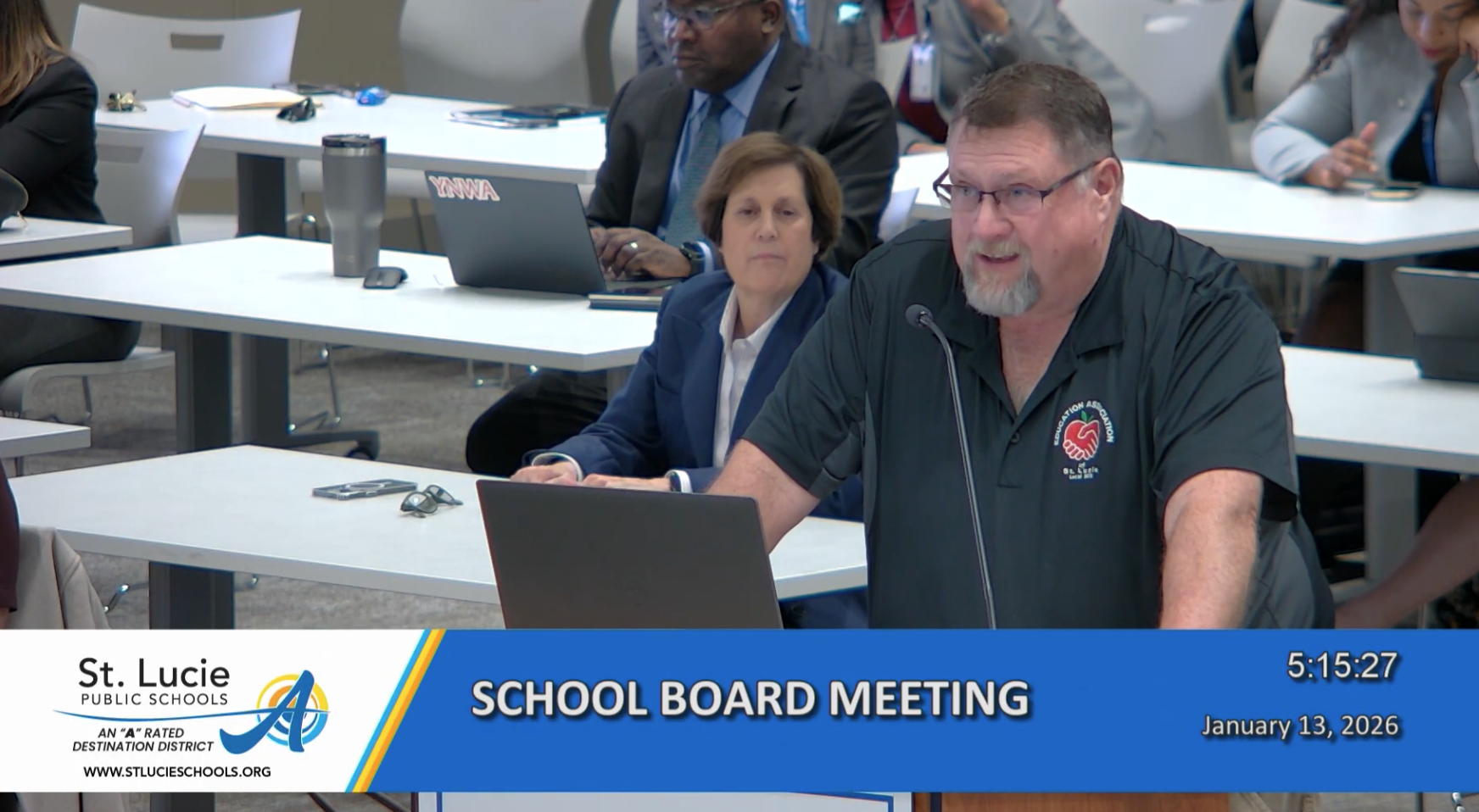
Transcript
Good evening, Chairman Ingersoll, Board members, Superintendent Prince.
Earlier this week, I gave an interview about educator vacancies and retention. In that conversation, I made one point unmistakably clear, and I want to restate it here tonight. The educator shortage in Florida is a state-created problem. It stems from decisions made at the state level, not by this board and not by this district. I drew that line intentionally. Accuracy matters, and so does credibility.
State policy caused the crisis.
Local culture determines how survivable it is.
We did not create the statewide problem, but we do have influence over how it is felt here. And in a moment when the profession is under extraordinary pressure, local choices can either soften the impact or unintentionally make it heavier. That is where our opportunity lies.
Right now, teachers are being asked to carry more responsibility than ever: instructional demands, documentation, interventions, communication, compliance. Expectations continue to grow, and almost nothing is removed to make space for what's added. I raise this not to point fingers, but because it highlights a tension we can address together: balancing necessary structure with trust in professional expertise to better support our students and keep talented educators here. This is about systems and signals, not individuals. When professional judgment is replaced with rigid control, the message educators hear is not about support or instructional quality. The result is less responsive teaching for students.
And to be clear, this is not about adult convenience. It is about instructional quality for students. The district and the union share the same goal: doing what is best for students. Where we sometimes differ is not on the goal, but on the method. We believe students are best served when effective teachers are trusted to practice their craft with minimal intrusion, and when intervention is targeted and warranted, not automatic. If St. Lucie County wants to retain experienced educators and attract new ones, trust matters. Autonomy matters. Respect matters.
That does not mean abandoning consistency or accountability. It means recognizing that effective teachers are professionals, and that their expertise, flexibility, and judgment are assets that strengthen student learning, not liabilities to be managed. In my interview, I did not criticize this district. That remains true. But as an advocate for educators in St. Lucie, I also have a responsibility to speak honestly about the conditions that push people out of the profession. Teachers do not leave because the work is hard. They leave when they feel controlled rather than respected.
We cannot fix the state tonight. But we can make St. Lucie a district where educators want to come, stay, and build long, meaningful careers, a district that turns a statewide challenge into a local advantage.
State policy caused the crisis.
Local culture will determine how we respond to it.
Thank you.